Support Built for Long Hours Behind the Wheel
Truck cabs and long-distance seats are taller, flatter and firmer than passenger car seats. That geometry leaves a gap exactly where the lower back needs support — and the hours spent in it are far longer.

Why Long-Distance Driving Strains the Lower Back
It is not one long drive that causes the trouble. It is the same posture held for hours, day after day.
Sustained Static Posture
Sitting loads the lower back far more than standing does, and a driving posture stays almost unchanged for hours. The deep postural muscles that normally share the load stop contributing, and the strain collects in the same place.
The Lumbar Gap in Cab Seats
Many truck and commercial-vehicle seats are built for durability and flatness rather than a lumbar curve. The result is an unsupported gap between the lower back and the seat backrest, which the spine fills by curving forward.
Vibration and Road Shock
Cabs transmit continuous low-level vibration and repeated shock through the seat. Over a full shift, that repeated loading is one of the reasons driver back complaints are so common across the industry.
Six Things That Matter in a Driver's Support
If you are sourcing for drivers rather than commuters, these are the properties that decide whether the product is still comfortable on hour eight.
- A deeper support profile that reaches the lumbar curve in a tall, flat cab seat rather than sitting below it
- Firmer foam that keeps its shape under sustained load instead of flattening by mid-shift
- A breathable cover that does not trap heat through a full working day
- A secure fit to the seat so the support stays in place through entry, exit and road shock
- Adjustability in height or firmness where several drivers share one vehicle
- A removable, washable cover — cab interiors get dirty in a way passenger cars do not
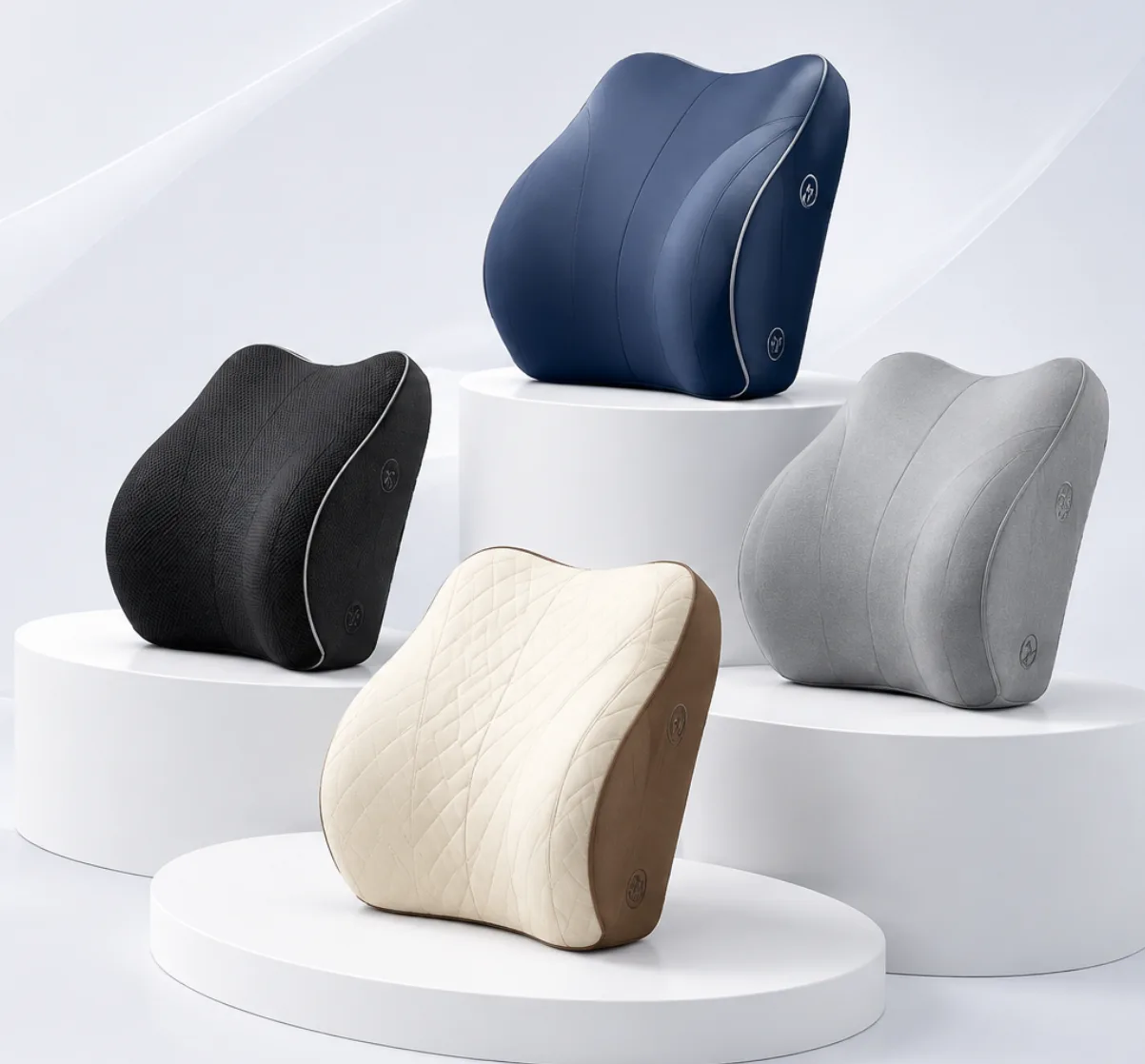
Three Constructions for Driver Seating
We build three support structures that suit long-distance and commercial driving, and can adjust each one for your target market and price point.
- Memory foam lumbar supports — the standard choice for steady, passive support over a full shift
- 2-in-1 lumbar and seat support — combined lower back and seat cushion for cab seats with limited adjustment
- Heavy-duty and commercial-vehicle variants — deeper profiles and firmer cores for trucks and long-haul fleets
Sourcing for Fleets and Drivers
Are these products designed for truck cabs specifically, or adapted from car seats?
Both, deliberately. Several lines are developed for truck cabs and long-distance seating from the start, with deeper profiles and firmer cores. Others are adapted from passenger-car platforms where the cab seat geometry allows it. We will tell you which is which for your particular seat type.
My drivers share vehicles with different seat heights. What do you recommend?
An adjustable model is usually the practical answer for a shared fleet. Inflatable structures let the driver set firmness and height on the spot, which removes the need to match one fixed support to several drivers and seat positions.
Can you brand the product for a fleet or a truck accessory brand?
Yes. We manufacture under client brands, with woven labels, embroidery or print depending on the cover material. Packaging can be plain, retail-ready or co-branded for a fleet programme.
Do you supply both single units and volume orders for this range?
Our focus is on wholesale and OEM/ODM supply rather than single retail units. Tell us your expected volume range in your inquiry and we will confirm what is practical for the type of customisation you need.
Sourcing support for drivers?
Tell us the seat type, the market you sell into and roughly what volume you expect. We will come back with the structures that fit and what can be adjusted.