Cooling gel or memory foam — the right car seat cushion depends on your climate, users, and retail channel. Compare price, margin, return rates, and MOQ across 7 buyer segments to pick the category your market will actually buy.
Cooling Gel Seat Cushion vs Memory Foam: Which Suits Your Market?
The "best" car seat cushion depends entirely on who sits in it — and that varies dramatically by region, climate, and use case. A cooling gel cushion that sells out in Texas will collect dust in Scandinavia. A memory foam cushion that attracts buyers in Germany will be returned in bulk from Saudi Arabia.
This guide compares cooling gel and memory foam car cushions on the five dimensions that drive distributor success: climate fit, target user, price positioning, wholesale margin, and return rates. Use it to decide which category to lead with in your catalog — and which to keep as secondary inventory.
Quick Comparison
| Dimension | Cooling Gel Cushion | Memory Foam Cushion |
|---|---|---|
| Best climate | Hot, humid (>25°C / 77°F) | Cool, mild (<25°C / 77°F) |
| Best user profile | Drivers in heavy traffic, rideshare, delivery | Long-distance commuters, older drivers |
| Price band (FOB China) | $4.50 – $9.00 | $3.50 – $7.50 |
| Typical retail markup | 3.0x – 4.0x | 3.0x – 4.5x |
| Weight per unit | 1.6 – 2.2 kg | 0.8 – 1.4 kg |
| MOQ (mixed SKUs) | 300 units | 200 units |
| Avg return rate | 2 – 4% | 3 – 6% |
| These are aggregate ranges from 2025–2026 export data. Your exact numbers will depend on factory, packaging tier, and freight terms. |
How Cooling Gel Cushions Work
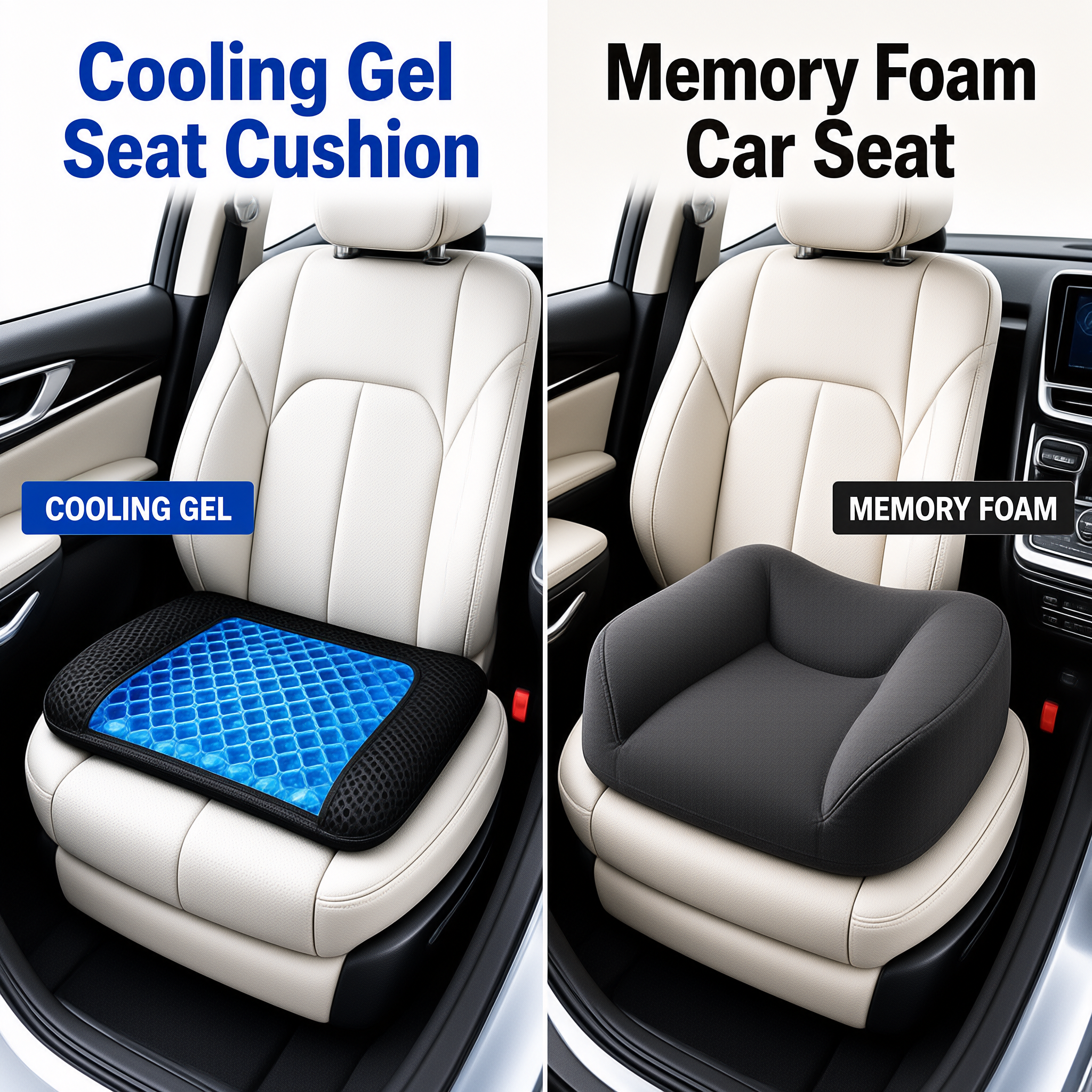
Cooling gel cushions use a layer of phase-change gel (usually 5–10mm thick) bonded to a foam or mesh base. The gel absorbs body heat, distributes it away from the pressure points, and gives a noticeable "cool to the touch" sensation for the first 10–20 minutes of sitting.
Most cooling gel cushions are not actively cooled. They do not require power, water, or refrigeration. They work by thermal absorption — heat moves from your body into the gel, which then radiates that heat over time. In a hot car with no ventilation, a passive gel cushion eventually warms up. The benefit is most pronounced in the first 20 minutes and in cars with working AC.
Common configurations:
- Single-layer gel over foam base (entry tier, $4.50–$6.00)
- Double-layer gel with mesh ventilation channels (mid tier, $6.00–$8.00)
- Gel + ventilated honeycomb or 3D mesh cover (premium tier, $8.00–$9.00)
The premium tier with honeycomb mesh is where most growth is happening, especially in markets where buyers are willing to pay $35–50 retail.
How Memory Foam Cushions Work
Memory foam (viscoelastic polyurethane) cushions mold to the driver's body shape under heat and pressure. They distribute weight across a wider surface area, reducing pressure points on the tailbone and lower back.
Memory foam cushions are temperature-sensitive in two ways:
- They feel firmer in cold weather (below 15°C / 59°F) and softer in warm weather.
- They retain body heat. In hot climates without AC, a memory foam cushion can feel uncomfortably warm after 30+ minutes.
This is why memory foam performs better in temperate and cold markets. In hot markets, memory foam tends to generate more returns related to "feels too hot" complaints — typically 4–6% return rate vs 2–4% for cooling gel in the same market.
Configurations:
- Standard density memory foam (50–60 kg/m³, entry tier)
- High-density memory foam (70–80 kg/m³, mid tier — what most OEMs spec)
- Memory foam + cooling gel hybrid (premium tier, targets both markets)
The hybrid tier is increasingly popular in markets that span both climate zones (e.g., the southern US, southern Europe, parts of Australia).
Climate and Region Fit
Match the cushion type to the climate where it will be used. Distributors who skip this step see 2–3x normal return rates.
Cooling Gel — Strong Markets
- Gulf Cooperation Council (Saudi Arabia, UAE, Kuwait, Qatar, Bahrain, Oman) — sustained >35°C
- Southeast Asia (Thailand, Indonesia, Vietnam, Malaysia, Philippines) — hot, humid year-round
- Southern Europe (Spain, southern Italy, Greece, southern France) — hot summers
- Southern US, Mexico, Central America, Caribbean
- Sub-Saharan Africa (Nigeria, Kenya, Ghana, South Africa)
- Northern Australia
In these markets, cooling gel cushions should be your primary category. Lead with single-driver or pair configurations in dark colors (black, charcoal) that match the most common car interiors.
Memory Foam — Strong Markets
- Northern Europe (UK, Germany, Netherlands, Scandinavia, Poland)
- Canada
- Northern US (New England, Midwest, Pacific Northwest)
- Russia, Central Asia
- Korea, Japan (winter-dominant driving)
In these markets, memory foam cushions perform better — drivers value the pressure relief and support more than the cooling effect. Climate-controlled cars (which dominate in cold regions) eliminate the heat-retention disadvantage.
Hybrid / Mixed Markets
- Central Europe (France, Belgium, Czechia, Hungary)
- Mid-Atlantic US, Midwest
- Southern Brazil, Argentina, Chile
- Turkey, Iran
- China (temperate and northern zones)
In mixed markets, carry both but lead with the hybrid (memory foam + gel) configuration as your flagship SKU. Pure gel and pure memory foam become secondary inventory.
Target User Profiles
The same cushion type appeals to different users depending on the climate, so user profile maps differently by region.
Cooling Gel Cushion Buyers
- Rideshare and taxi drivers — spend 6–10 hours per day in the car, often in heavy traffic with intermittent AC. The 20-minute cooling window aligns perfectly with passenger stops.
- Delivery drivers — same use pattern, plus the gel cushion helps during the loading/unloading breaks when they return to a hot seat.
- Truck drivers — long-haul in hot climates (southern US, Gulf, Australia, southern Spain).
- Older drivers in hot climates — often have thinner skin and reduced sweating efficiency, making heat accumulation more uncomfortable.
- Post-surgery or medical need — patients who cannot tolerate heat buildup (lymphedema, multiple sclerosis, post-mastectomy).
Memory Foam Cushion Buyers
- Long-distance commuters — daily 1–3 hour drives, especially on highways where AC is consistent.
- Truck and van drivers in temperate climates — long-haul in cooler regions (Canada, northern US, northern Europe).
- Older drivers with back pain — memory foam provides more pressure-point relief for lower back and tailbone issues.
- Office workers who double as drivers — value the consistent feel across both contexts.
- Wheelchair users — memory foam cushions are more widely accepted as medical devices than gel cushions.
Price Positioning and Wholesale Margin
Cooling gel cushions are typically priced $1–$2 higher than memory foam at the factory gate, but they also command higher retail prices. The net wholesale margin is similar for both.
Cooling Gel — Cost Structure
- Factory gate (FOB China): $4.50–$9.00 per unit depending on tier
- Standard retail markup: 3.0x–4.0x
- Retail price range: $14–$36
- Wholesale margin (for distributor): typically 18–28% of retail
- Shipping weight premium: +0.7–0.8 kg per unit vs memory foam (gel adds weight)
Memory Foam — Cost Structure
- Factory gate (FOB China): $3.50–$7.50 per unit
- Standard retail markup: 3.0x–4.5x
- Retail price range: $11–$34
- Wholesale margin (for distributor): typically 20–30% of retail
- Shipping weight: lighter, often qualifies for cheaper shipping tiers
If your market is price-sensitive (Mexico, Indonesia, parts of Africa), memory foam at $3.50–$5.00 entry tier gives you a lower entry price. If your market values differentiation and is climate-hot, the cooling gel premium tier ($7.00–$9.00) at 3.5x retail gives better margin per square inch of shelf space.
Return Rates: What the Data Actually Shows
Return rates are the strongest signal of product-market fit. Both cushion types have a baseline 2–6% return rate, but the reasons differ.
Cooling Gel Returns
- "Doesn't cool enough" — 35–45% of returns (mostly expectations mismatch)
- "Gel feels too hard" — 15–25% (mid-tier gel without mesh ventilation)
- "Cover fabric too hot" — 10–15% (synthetic covers in direct sunlight)
- "Defective seam" — 5–10%
- "Wrong size for my seat" — 5–10%
Most cooling gel returns are preventable with better product description and visualization. The "doesn't cool enough" returns are dominated by buyers who expected active cooling (battery, water) — your product page should explicitly say "passive thermal absorption, no power required."
Memory Foam Returns
- "Feels too hot" — 40–55% of returns (mostly in hot climates)
- "Too firm" — 15–20% (cold weather makes memory foam temporarily stiffer)
- "Doesn't bounce back" — 10–15% (low-density foam below 60 kg/m³)
- "Off-gassing smell" — 5–10% (first 2–3 days after unboxing)
- "Wrong size" — 5–10%
Memory foam returns cluster around temperature and firmness. In hot climates, the temperature returns dominate — usually the #1 reason memory foam underperforms in GCC, SEA, and southern Europe.
If your market has a return rate above 5% for either cushion type, the cause is almost always climate mismatch or weak product-page copy, not factory quality.
MOQ and Inventory Planning
The minimum order quantities differ between the two cushion types, and that affects how aggressively you can test a market.
Cooling Gel MOQ
- Mixed SKUs across 3–5 colors: typically 300 units
- Single SKU single color: 100–150 units (some accept 100, most push 200)
- Custom color (Pantone match): 500 units per color
- Custom logo on existing model: 200 units minimum
Cooling gel has a higher MOQ because the gel layer adds production line setup time. If you're testing a new market, plan for 200–300 units as a minimum viable catalog.
Memory Foam MOQ
- Mixed SKUs across 3–5 colors: typically 200 units
- Single SKU single color: 100 units (most factories accept this)
- Custom density: 300 units
- Custom logo on existing model: 100 units
Memory foam is more forgiving for testing. A 100-unit test order is reasonable for most factories.
If your catalog is established in one category and you're testing the other, plan for:
- 100–200 units if testing memory foam into a hot market (low commitment)
- 200–300 units if testing cooling gel into a cool market (medium commitment)
- 300–500 units if launching a hybrid model into a mixed-climate market (higher commitment but higher margin)
Which Should You Lead With?
Three quick rules to choose your primary category:
Lead with cooling gel if:
- Your market is hot (>25°C / 77°F for 6+ months per year)
- Your buyers include rideshare, delivery, or taxi drivers
- Your retail channel can support $25+ price points
- You can commit to 300+ units initial order
Lead with memory foam if:
- Your market is cool to temperate (<25°C / 77°F average)
- Your buyers are long-distance commuters, older drivers, or back-pain sufferers
- Your retail channel is value-positioned ($15–$25 price points)
- You can start with 100–200 units initial order
Lead with hybrid (memory foam + gel) if:
- Your market spans both climate zones
- You want a single flagship SKU that performs year-round
- Your buyers are quality-positioned and willing to pay $30+
- You can commit to 500+ units initial order
Conclusion
Cooling gel and memory foam serve different climates and different users — they are not direct competitors. The distributors who do best pick one as primary based on their market climate and user profile, then add the other (or a hybrid) as secondary inventory.
For distributors in hot markets: lead with cooling gel, expect 2–4% return rates, and target rideshare/delivery buyers first. For distributors in cool markets: lead with memory foam, expect 3–5% return rates, and target commuters and older drivers first. For mixed markets: lead with the hybrid tier and use it as a year-round flagship.
The single biggest mistake is choosing based on your local preferences rather than your market's climate. If you're sourcing from China and your market is GCC, lead with cooling gel even if you've personally never felt the need for one. If your market is northern Europe, lead with memory foam even if cooling gel is what you'd buy for yourself.
Looking for OEM/ODM car seat cushion sourcing with climate-matched product guidance? Contact our team with your target market and we'll send a sample pack with both cushion types for buyer testing.